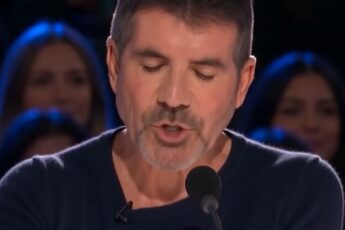
“So, Jimmy, when you started singing, I went, oh. But then I started listening, and you sung that with such emotion. I absolutely really felt it. Well bloody done.” The praise from Mel B landed like a hand on the shoulder—steadying, sincere, and earned. Jimmy Rose had the kind of voice you don’t forget. But more than that, he carried a life’s worth of work and worry straight to the mic and let it ring out.
The coal miner with a song
He introduced himself the way a neighbor might. “My name is Jimmy Rose.” He was “from Pineville, Kentucky,” a four-year “United States Marine Corps veteran,” and “a former coal miner.” Then he said the line that shifted the room: “I’m gonna be singing you an original song called coal keeps the lights on.”
He did not swagger. He settled onto his stool and sang about work boots and mornings before dawn, about a man who slips through a back door to keep from waking anyone, about the families behind every shift. It was plain-spoken poetry, the sort that doesn’t strain to impress. The audience rose to its feet, and the judges leaned in.
“That was a damn good song.”
“As a programmer of radio stations, I would have added your record and put it on the air.”
“You have a very beautiful, very natural voice, very strong.”
In minutes, Rose moved from the mine to the mainstream. The yeses came fast—“It’s a big old yes for me”—and he stepped offstage looking a little stunned. In Pineville, signs would soon go up. “Pineville is Proud to be the Home of Jimmy Rose,” one marquee declared. At home and on the road, people cried, smiled, and told him he made them proud.
The story behind the sound
Rose had been singing in church with his mom since he was a kid. “I’ve always kinda had this fire inside of me,” he said, but he chose the path that was open and steady after high school: straight underground. Coal mining is “very dangerous,” he explained. And when he decided there were risks worth more than a paycheck, he joined the Marines and deployed to Iraq. Somewhere in that life, he learned guitar. Later, back in Kentucky, he went to community college and held onto the old spark.
“I don’t ever wanna be that guy that never had the opportunity to chase my musical dream,” he said. “I wanna be the guy that chased it.” After his audition, he added something simple and big: “If you have a dream, it will come true. Chase it.”
Family anchored him. “Mom was the first one that really inspired me to even wanna get up and sing,” he said, remembering how she’d lift a sanctuary with a hymn and a quiet fierceness. She was battling congestive heart failure. “She’s a fighter,” he said. “She’s taught me to fight.” When he performed at Radio City Music Hall, he was carrying her lessons as much as his guitar.
When heart meets the spotlight
At Radio City, Rose leaned again on feeling. “You sing from the heart,” Heidi Klum told him. “I think that America will vote for you, and I think that all the other country singers on the show, they have to watch out for you, boy.” The room had one of those hushes where you hear breath and hope in equal measure. Mel B, hearing him lift one of her favorite songs in a different way, admitted, “For me personally, that didn’t hit the spot.” But even in disagreement, the panel kept circling his center: voice, warmth, and grit.
Howie Mandel put it more coolly. “I think you did a good job. I don’t know that it was exciting,” he said, adding that America tends to reward what feels true. Howard Stern—the King of All Media who has spent a lifetime in headphones—drove a point home: “They’ve gotta judge on talent and not the backstory, and that’s the key here.”
Rose took it all in. “Sometimes I find myself standing on stage and just looking around thinking, is this really happening to me?” he said later. His answer came in workmanlike form: keep showing up, sing what you know, let the room decide.
The push for a knockout
As the weeks stacked up, the standard rose. “You are competing against Kenichi, the Chicago Boyz… toughest decision ever,” Howie warned on a night loaded with standing ovations. Stern, consistent to the end, pressed again: “You need a knockout punch. Tonight’s the big night.” Even Heidi, one of Rose’s most steadfast champions, gently admitted he stayed “in your comfort zone, but it works. It’s so beautiful.”
Mel B swung the other way in one of his later turns. “You’re just a great performer,” she said. “I love the sound of your voice. I wanna hear your voice on the radio. If you had an album out tomorrow, I would definitely go and buy it.” Howie, comparing a Garth Brooks cover to the original, said he heard a “really good, nice rendition… but not great.” It was the push and pull that defines a season: the audience fell for the man and his music; the judges kept asking for more.
Rose kept leaning on what brought him: a clear tone, an easy stage walk, and the coal-country truths that powered his original. “The reason I wanna sing it again,” he said about his hometown song, “is it goes back to that true side of me.” He wasn’t trying to outrun his lane. He was trying to deepen it.
Hometown pride, national stakes
The show cut between bright lights and small-town scenes: a “Welcome to Pineville” sign, photos of Rose in uniform, a bulldozer filmed after a dusty shift, a yellow glow flooding a stage while a band eased in behind him. Back home, crowds cheered. Onstage, he heard the same mix: praise for his voice, calls for danger, reminders that a million dollars demanded a headline moment. He absorbed it all and smiled, that half-shy, half-grateful grin of a man who has worked in the dark and still trusts the morning.
He told a truth most dreamers understand. “Some people go their whole life and just dream, and they never get the opportunity to even open the first door,” he said. “Up until now, I was just a dreamer.”
Soon enough, the doors widened. He reached the top 12—then the top 6. “If you don’t ever take chances in life, you don’t ever know the outcome,” he said before another walk under the lights. The risks were no longer about rockfalls or convoys. They were about song choices, dynamics, and whether a performance could rise above “nice” and into “necessary.”
A finale built on work and wonder
By finale week, Rose had become the show’s portrait of likable grit. The judges kept at him, but they also kept standing for him. “You own that stage,” Mel B told him. “You’ve really grown on me… Talented and humble.” Stern saw a singer “very good” but still playing it safe with emotion. Howie, hunting for one last spark, admitted, “I’m just looking for that wow moment, and I didn’t go wow. But you’re great.”
Then came the capstone: a duet with country star Dierks Bentley. Two guitars. Two workingman voices. No tricks. Rose didn’t pretend to be a different artist; he showed everyone who had voted for him why they were right to do it. The handshake afterward felt less like TV and more like a promise—that rooms beyond Radio City would hear him soon.
When the results came, the stage was crowded with hope. He stood beside finalists, took a breath, and listened. America had voted. He finished third—high enough to feel the air at the summit, close enough to see what one more step might require. He smiled through it, the way people do when they recognize the journey has only changed gears.
The legacy of a coal song
Howard Stern’s early advice—“judge on talent and not the backstory”—never stopped being true. But in Jimmy Rose’s case, the talent and the story were never separate. The song that introduced him was not a stunt; it was a life. He wrote it because he watched the coal industry go lean and the people he loved tighten their belts. He sang it because he believed music should pull its weight. And he kept returning to its roots because it told listeners exactly who he was.
That is why the audience kept standing. It is why Heidi told him, “You sing from the heart.” It is why Mel B could go from “didn’t hit the spot” one week to “I would definitely go and buy it” the next. It is even why Howie’s and Stern’s tougher words mattered: they respected him enough to ask for more.
In the end, the man from Pineville proved something simple and rare on a stage built for spectacle: steadiness can still surprise you. A Marine who risked his life “for my country.” A miner who knew the price of power. A son who said of his ailing mother, “She’s a fighter. She’s taught me to fight.” He carried all of that into a mic and let it guide him to a finale night handshake with a country star and a third-place finish that felt like a first step.
Rose once said he didn’t want to be the guy who never chased it. He isn’t. He took his shot, he kept his tone true, and he left with something no judge can score: a lane that belongs to him. Watch the full performance journey, from that first original to the finale duet, and see how a hometown story became a national stage—and why the next chapter might be the best one yet.